Studio Services
Custom software and premium websites, built with product-level care.
Reed Creative Labs works with small businesses, independent professionals, creators, and organizations on focused digital projects that need clear design, maintainable engineering, and direct technical communication.
Internal RCL project
You are using one example of our work.
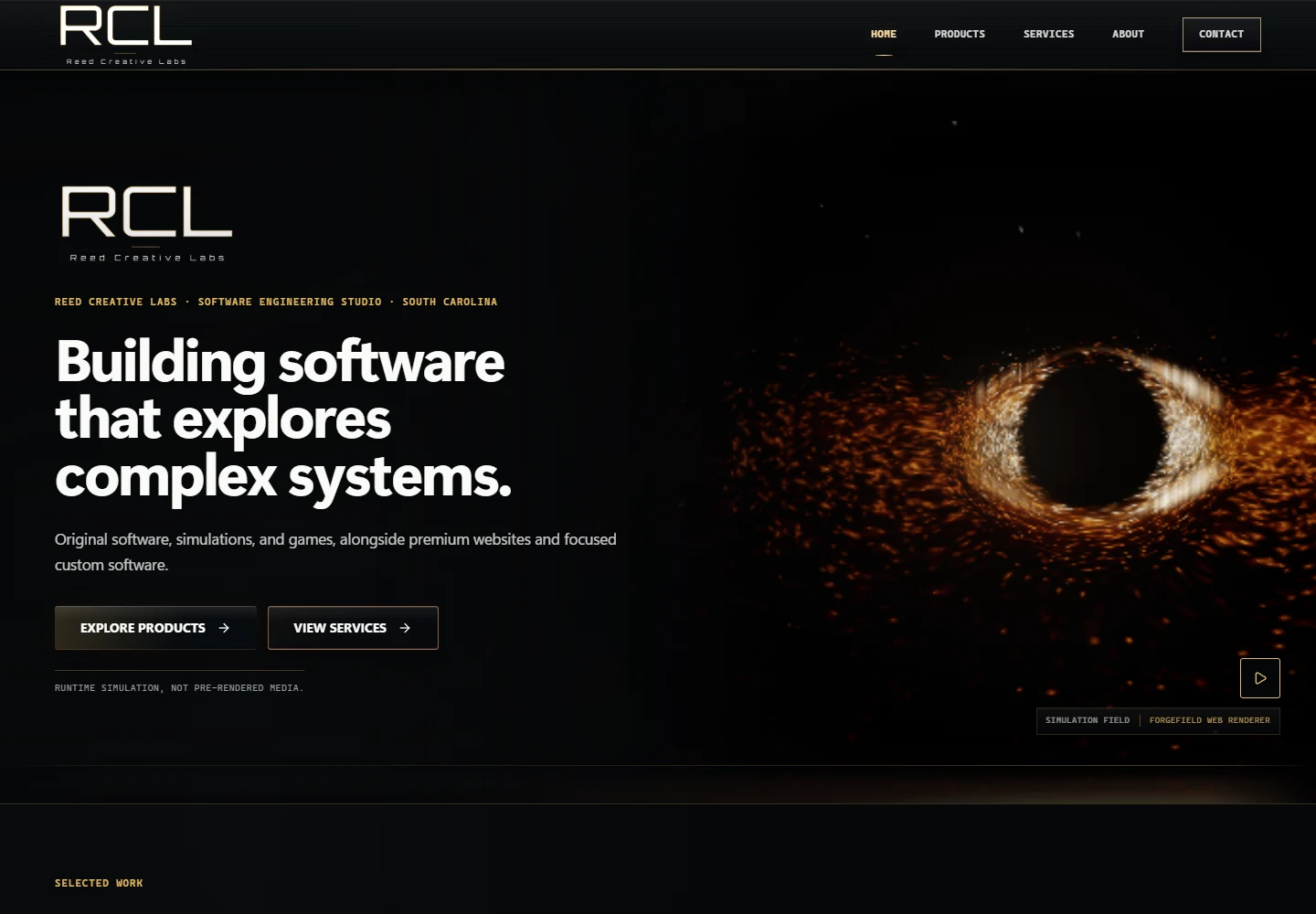
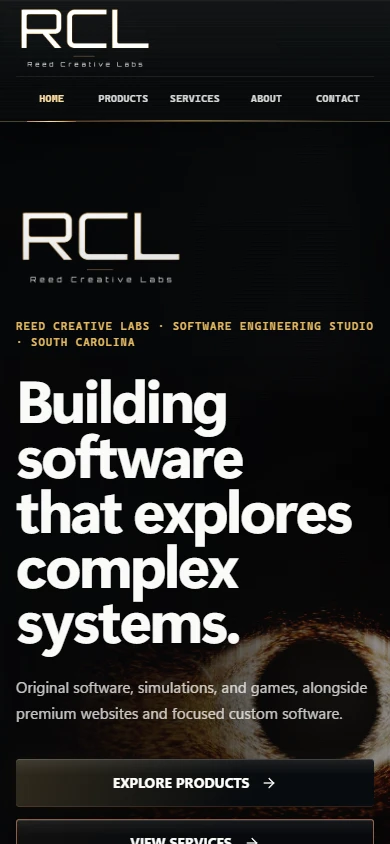
This website is designed and built by RCL. Its live simulation, responsive composition, and fallbacks make the engineering decisions visible, not just the finished surface.
- Live rendering
- A Fortran numerical kernel runs in WebAssembly. The browser renders its state without a native server process.
- Responsive art direction
- The renderer, text protection, and controls respond to the viewport. Constrained and reduced-motion experiences use a deterministic still.
- Useful without the effect
- Product information and navigation remain HTML. Playback can be paused, and the renderer pauses when hidden or offscreen.
What we build
Four service disciplines.
Each project is narrowed to work the studio can design, build, test, and hand off responsibly.
Premium Websites
Custom, responsive websites built around the client's business, brand, audience, content, and goals.
- New business websites and redesigns
- Responsive, accessibility-minded implementation
- Performance, search, and metadata foundations
- Contact, quote, and established service integrations
- Deployment guidance and documented handoff
The work is designed and implemented for the project. RCL does not sell template swaps as custom websites or promise search rankings, conversions, or business growth.
Custom Software
Focused software built to simplify a defined operational problem or replace a repetitive, spreadsheet-heavy workflow.
- Internal business and workflow tools
- Data import, export, and reporting systems
- Lightweight customer or job-management tools
- Local-first applications
- Purpose-built utilities and automation
Best suited to maintainable tools with clear users, workflows, data responsibilities, and scope rather than open-ended enterprise platforms.
Desktop Applications
Focused Windows-first or cross-platform desktop software for work that benefits from local storage, offline use, or direct file access.
- Local-first and offline workflows
- File import and export
- Reporting and data visualization
- Focused interfaces and packaging
- Windows-first or cross-platform delivery where appropriate
Platform support, installers, update behavior, storage, and handoff requirements are confirmed during scoping rather than assumed for every project.
Data Visualization & Interactive Software
Interactive tools that help people inspect complex information, processes, simulations, or technical data.
- Interactive data exploration
- Process and systems visualization
- Educational and explanatory software
- Simulation interfaces
- Technical prototypes and focused experiences
The project defines its data sources, assumptions, intended use, and validation needs. Visual presentation alone is not represented as formal scientific validation.
Who we work with
Small teams with a problem worth defining well.
RCL is a small independent studio. Clients work directly with the people designing and building the project.
Best suited for
- Small businesses
- Independent professionals
- Creators
- Small organizations
- Technical founders
- Teams with a clearly defined problem
The strongest fit is a client who values custom design, maintainability, practical scope, and clear decisions.
What makes a good project
A small business needs a polished website that better represents the quality of its work.
An existing site is outdated, slow, confusing, or difficult to use on mobile.
A team relies on spreadsheets or repetitive manual steps that could be simplified.
A business needs a focused internal tool rather than a large enterprise platform.
A technical concept needs a clear interactive visualization.
A desktop utility needs to work reliably without unnecessary cloud infrastructure.
Our process
A defined path from inquiry to handoff.
Review points and responsibilities are matched to the work. There is no assumption of unlimited revisions or indefinite support.
Initial Conversation
Understand the business, users, problem, constraints, existing material, and desired outcome.
Scope and Proposal
Define deliverables, exclusions, dependencies, responsibilities, estimated timing, and project-based pricing in writing.
Design and Development
Build the approved work in defined stages with review points appropriate to the project.
Testing and Validation
Check core workflows, responsive behavior, accessibility, performance, and release behavior where they apply.
Launch and Handoff
Deploy or package the finished work, provide agreed documentation, and transfer the access or ownership defined in the proposal.
Ongoing Work
Future updates, maintenance, support, and additional features are scoped separately unless the original agreement includes them.
Project-based pricing
A quote built from the work required.
Every project is scoped and quoted individually. Pricing depends on complexity, pages or workflows, integrations, design requirements, timeline, testing needs, and expected support.
After an initial discussion, RCL provides a written project scope, estimated timeline, responsibilities, exclusions, and quote before development begins.
A smaller brief can still be carefully built. Start with the essential pages or workflow; additional work can be scoped separately.
Scope and limitations
Responsible boundaries are part of the work.
RCL focuses on restrained, well-defined projects where a small studio can provide careful implementation and a clear handoff. Established third-party services may be integrated when appropriate.
Large enterprise platforms or massive multi-team systems
Social networks and complex marketplaces
Regulated medical, legal, or financial systems
Projects requiring RCL to operate extensive always-on cloud infrastructure
Custom payment-processing infrastructure
Open-ended engagements without a defined scope
Unsupported third-party systems
Work with unclear ownership of content, code, assets, or data
Hosting, ownership, and services
Accounts and responsibilities stay clear.
Project-specific details belong in the written proposal. These are the studio's general working expectations.
- Domain and hosting
- Clients should own their domain and, where practical, their hosting account. RCL can assist with configuration and deployment within the agreed scope.
- Third-party services
- Payment, analytics, scheduling, email, commerce, and similar accounts should remain client-owned. RCL may configure established services when the project calls for them.
- Maintenance and fees
- Hosting administration, content updates, maintenance, support, and third-party fees are not automatically included unless the written proposal lists them.
- Ownership and licensing
- The agreement defines ownership and licensing for custom code, design work, client-provided material, and third-party components before development begins.
Frequently asked questions
What to expect before work begins.
Do you work with small businesses?
Yes. RCL is well suited to small businesses, independent professionals, creators, and organizations that need focused, high-quality work and direct communication with the person building it.
Can you redesign an existing website?
Yes. A redesign can address structure, usability, responsive behavior, performance, accessibility, visual presentation, and content organization. The scope depends on the existing site, available content, and systems that must remain connected.
Do you build custom software?
Yes. RCL builds focused internal tools, workflow applications, desktop utilities, reporting systems, data tools, and local-first software when the problem and operating requirements can be clearly defined.
Do you provide hosting?
RCL can assist with setup and deployment, but generally prefers client-owned hosting, domain, and service accounts. Ongoing administration is included only when it is separately scoped.
How much does a project cost?
Every project is scoped and quoted individually. Cost depends on complexity, pages or workflows, integrations, design requirements, testing, schedule, and expected support. A written scope and quote are provided before development begins.
How long does a project take?
Timing depends on scope, content readiness, feedback speed, integrations, and technical complexity. The proposal provides an estimated schedule after those factors are understood; RCL does not promise one universal turnaround.
Who owns the finished work?
Ownership and licensing are defined in the project agreement. The proposal identifies the treatment of custom code, design work, client-supplied assets, and third-party components before work begins.
Can you maintain the project after launch?
Potentially. Maintenance, support, content updates, and additional development are scoped separately unless the original agreement explicitly includes them.
Do you build e-commerce or booking systems?
RCL may integrate established hosted commerce, payment, or scheduling services when they fit the project. The studio does not currently position itself as a builder of large custom commerce or payment infrastructure.
What do you need before starting?
A useful first conversation covers the business or organization, intended users, the problem to solve, what already exists, required content or data, known integrations, constraints, timing, and who can approve decisions.
Have a focused project in mind?
Tell us what you are trying to build.
Include the problem it should solve, who it is for, what already exists, and any constraints you already know about.